Sports and Media
Gaelic Football: Ireland's Hidden Sporting Treasure
Gaelic Football, GAA, Gaelic Athletic Association, Irish Culture, Irish Sports, Amateur Athletes, Community Sport, Croke Park, Dublin, County Championships, Irish Tradition, Gaelic Games, Hurling, Gaelic Handball, Rounders, Irish Heritage, Local Pride, National Identity, Volunteer Spirit, Irish Community, Irish Diaspora, Cultural Preservation, Irish History, Women’s Gaelic Football, Ladies Gaelic Football, Ireland, Irish Fans, Match Day Experience, Irish Stadiums, Traditional Sports, Non‑Professional Sports, Amateur Ethos, Irish Passion, Gaelic Clubs Abroad, Athletic Dedication, Local Heroes, Irish Pride

Ever wondered what would happen if you mixed soccer, rugby, and basketball into one wild game? That's basically Gaelic Football, and it's absolutely massive in Ireland. Yet somehow, most of the world has never heard of it.
Here's the kicker: the players don't get paid a single cent. Zero. Nothing. They all have regular jobs, train in the evenings, and play on weekends purely for the love of it. In 2025, when sports are multi-billion dollar industries, this feels almost rebellious.
The Beautiful Simplicity
Let's start with the basics because they're surprisingly simple. Two teams of 15 players each battle it out on a huge grass field. At each end stands an H-shaped goal that looks like rugby posts but with a net hanging underneath.
You can score two ways. Kick or punch the ball over the crossbar between the posts? One point. Get it into the net below the crossbar? Three points. That's it. Simple scoring, endless excitement.
The ball looks like a slightly chubby volleyball made of leather. You can kick it, punch it to teammates (called a hand-pass), or catch it out of the air. But here's the catch: once you grab it, you only get four steps. Then you must do something with it.
Four steps. That's all.
After four steps, you either pass it, kick it, or do this clever move called a toe-tap where you drop the ball onto your foot and kick it back to yourself. This resets your step count. Want to keep running? You'll need to bounce the ball or keep toe-tapping it every four steps, sort of like dribbling in basketball but way harder.
The Game in Action
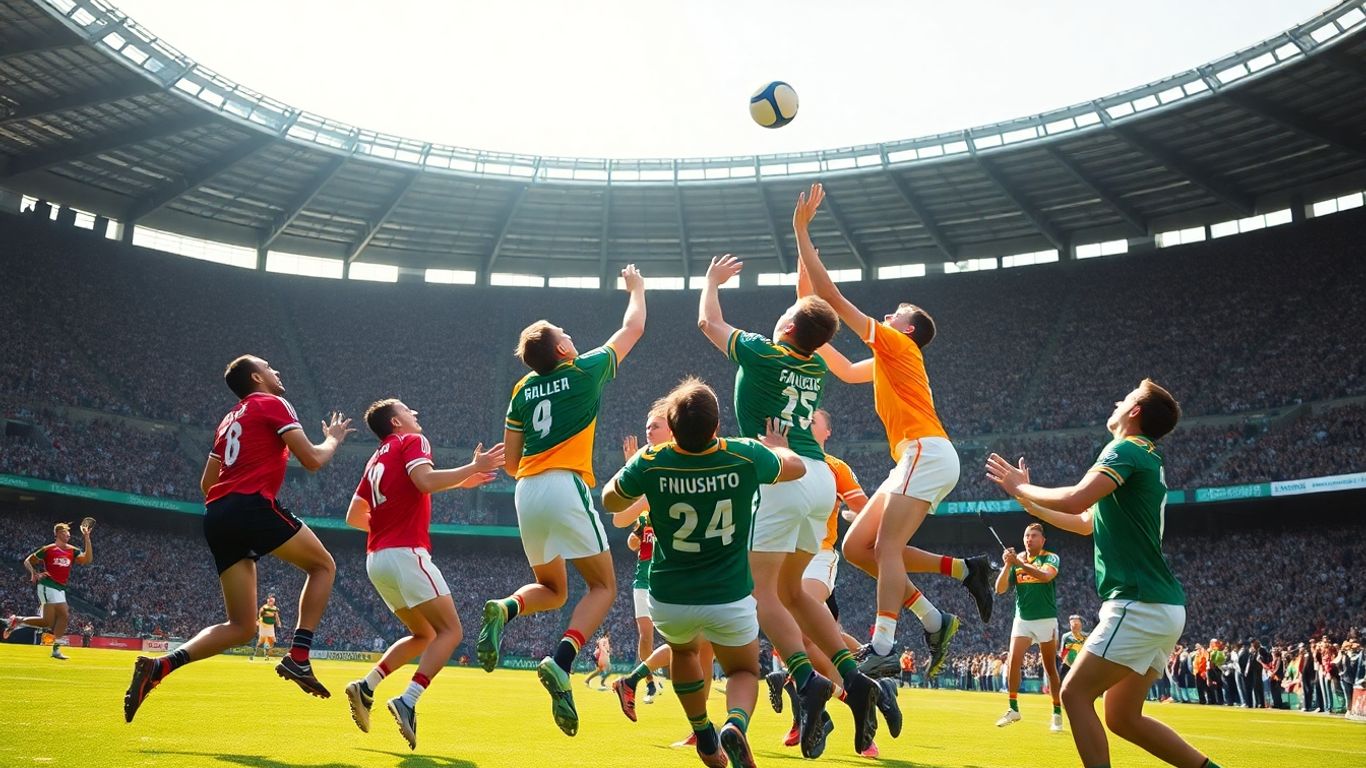
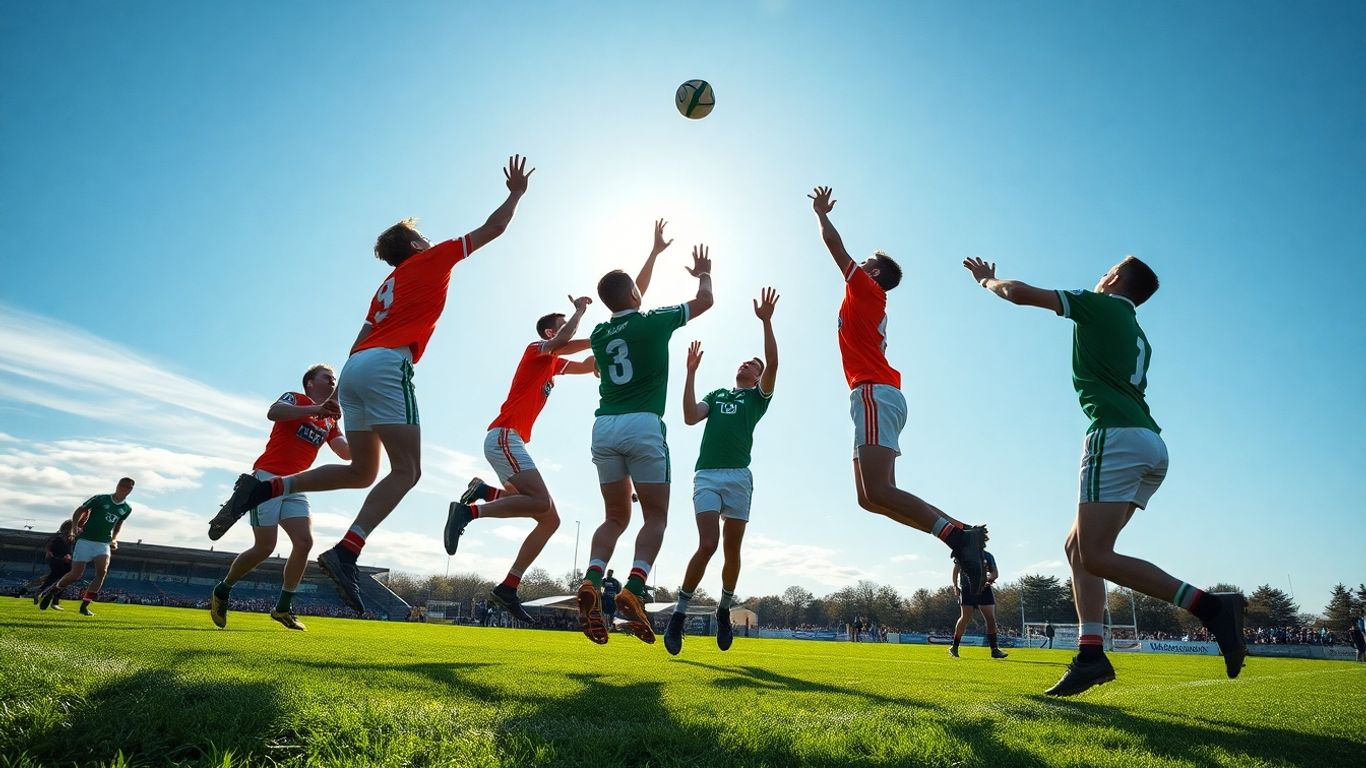
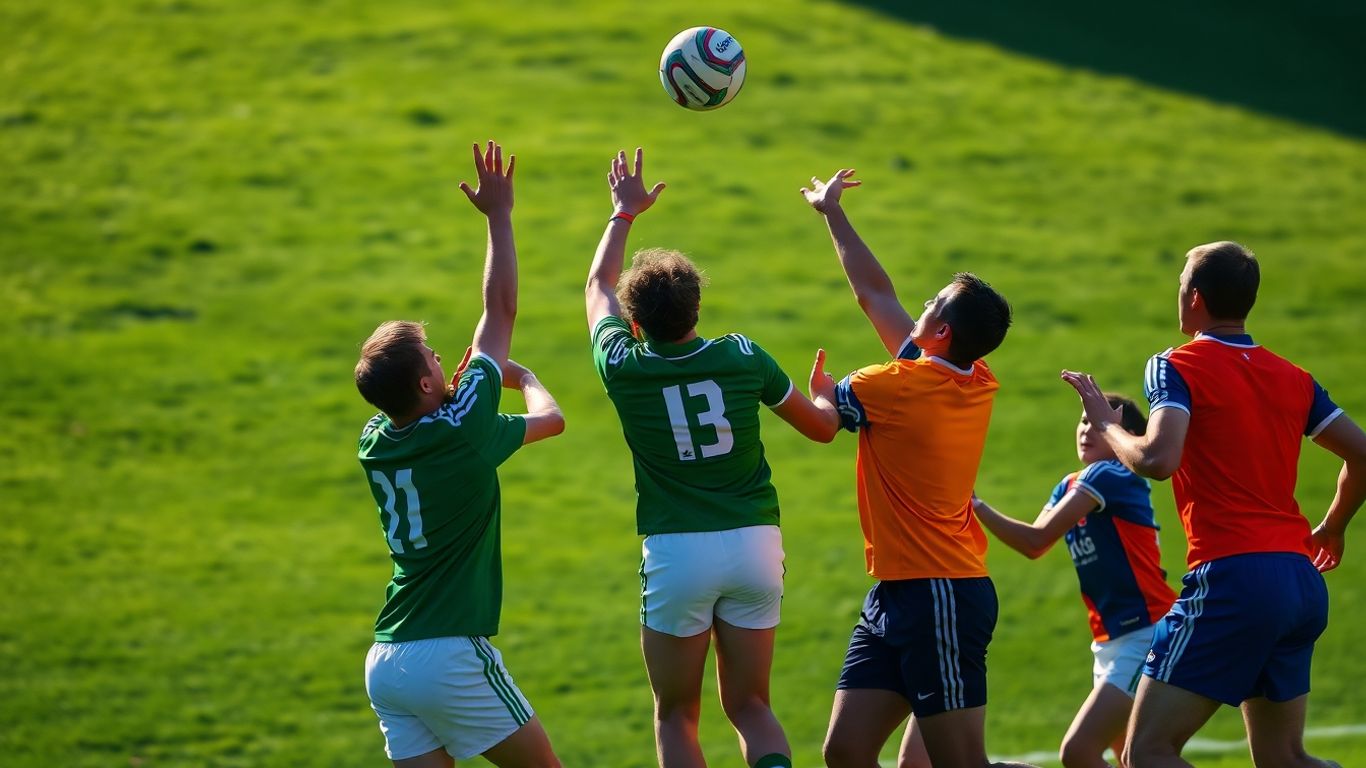
Watching Gaelic Football is mesmerizing. The ball flies through the air in massive arcing kicks. Players leap high to catch it, bodies colliding mid-air, arms stretched skyward. Someone snatches it, sprints their four steps, then fires a perfect hand-pass to a teammate who's already racing forward.
The speed never lets up. There's kicking, catching, bouncing, dodging. A defender blocks a shot with their body. A midfielder wins possession and launches a huge kick downfield. A forward catches it near the goal, takes their steps, and smashes it into the net. Three points. The crowd goes absolutely wild.
The physicality is real but controlled. You can shoulder-charge an opponent (think hockey-style body checks), smack the ball from their hands, or block their kick with your body. What you absolutely cannot do is trip them, yank their jersey, push them from behind, or wrestle them to the ground. It's aggressive without being dirty, intense without being dangerous.
One fascinating rule protects the goalkeeper. Inside their small rectangular area (the "small square"), they're completely safe. No opponent can touch them there. It's their sanctuary, and invading it means an instant foul.
Nobody Gets Paid (And That's The Point)
This is where Gaelic Football gets really interesting. In an age when athletes sign hundred-million dollar contracts and teenagers become overnight millionaires through sports, Gaelic Football has remained stubbornly, proudly amateur for over 140 years.
The Gaelic Athletic Association (GAA), founded back in 1884, runs the show. Their rule is iron-clad: no payments to players, coaches, or managers. Ever. The guy who scores the winning goal in Sunday's championship final? He's probably going to work on Monday as a teacher or carpenter or accountant.
So why do they do it? Why train like professionals while working full-time jobs? Why sacrifice time with family and friends?
Pride. Pure, simple pride.
Representing your county in Gaelic Football is like representing your country in the Olympics. It's the highest honor your community can give you. These players train as hard as any professionals, following strict fitness regimes, attending tactical sessions, pushing their bodies to the limit. But they do it for glory, not money.
This creates something magical. When your kid's schoolteacher or the local plumber scores the winning point, it means something different. These aren't distant celebrities living in mansions. They're your neighbors. They coach the youth teams, they show up at community events, they live in the same world as everyone else.
The sport stays real because the players stay real.
Behind the scenes, an army of volunteers keeps everything running. People organize matches, maintain fields, coach youth teams, handle paperwork, all without pay. These volunteers are the backbone of Irish sporting culture, dedicating countless hours because they believe in something bigger than themselves.
The Match Day Experience
Attending a Gaelic Football match is unforgettable. The biggest games happen at Croke Park in Dublin, a massive stadium holding over 82,000 fans. But you don't need a major championship to feel the magic. Even small town matches crackle with energy.
Families arrive together, three generations wearing their county colors. Grandparents who've attended for 60 years stand beside grandchildren seeing their first match. The atmosphere buzzes with anticipation, passion, and genuine community spirit.
Unlike many sports where rival fans must be separated for safety, Gaelic Football crowds mix freely. There's fierce competition and intense rivalry, but it's wrapped in mutual respect. Everyone's passionate, but the underlying message is clear: we're all Irish, and this is our game.
When someone scores a goal, the roar is deafening. When a defender makes a crucial block, everyone's on their feet. Between plays, traditional Irish songs echo across the stands. Friendly banter flows between opposing supporters. The announcer's thick Irish accent provides running commentary that visitors might find challenging but locals love.
After the final whistle, win or lose, something special happens. Players and fans often gather together, sharing stories over drinks, rehashing great plays, laughing about mistakes. The barriers between athlete and spectator barely exist. It's sport as it was meant to be: part of the community, not separate from it.
Summer is peak season, with county championships drawing huge crowds. But games happen year-round, and finding one to attend isn't difficult. Tickets are remarkably cheap compared to professional sports, usually just a few euros for local matches. Major finals cost more but remain affordable by international standards.
Women Play Too
Ladies Gaelic Football deserves major recognition. Governed by its own association but following essentially the same rules, women's Gaelic Football showcases equally impressive skill and fierce dedication.
This isn't some afterthought or lesser version. It's legitimate sport in its own right, with its own championships, stars, and passionate following. The players are just as committed, training just as hard, playing with just as much heart. They also receive zero payment, embracing the amateur ethos completely.
The fact that both men's and women's Gaelic Football thrive without professional status while other sports struggle to gain attention says everything about the sport's cultural importance. This isn't about money. It never was.
The Cultural Context
Gaelic Football sits within a family of traditional Irish sports called Gaelic Games. The most famous sibling is hurling, often called the fastest field sport on Earth. Players use wooden sticks to strike a small ball at terrifying speeds. It's absolutely wild to watch.
There's also Gaelic handball (like squash but different) and rounders (similar to baseball). All serve a purpose beyond entertainment. They're vessels for Irish culture and identity.
When the GAA was founded in 1884, Ireland was under British rule. Promoting native Irish sports was an act of cultural preservation and even political resistance. That history still resonates today. Gaelic Football isn't just a sport; it's a living connection to Irish heritage.
Newcomers sometimes confuse Gaelic Football with rugby because both use similar goal posts and allow physical contact. Watch for five minutes and the differences become obvious. The hand-passing, the four-step rule, the bouncing, the scoring system create something completely unique. It's not rugby, not American football, not soccer. It's purely, distinctively, defiantly Irish.
Why This Matters
In our globalized world where the same sports dominate everywhere, Gaelic Football stands as beautiful rebellion. It chose community over commerce. Tradition over profit. Local pride over international expansion.
It's not trying to compete with the Premier League or NFL. It's not chasing television deals in America or Asia. It's not desperate for global attention. Instead, it simply exists as it always has: a game played by ordinary people for the joy of competition and love of their community.
This authenticity is increasingly rare. Most sports have been commercialized, branded, packaged, and sold. Gaelic Football remains stubbornly uncommercial. The GAA owns its stadiums, runs its competitions, and answers to its members, not corporate sponsors or television executives.
For visitors to Ireland, catching a match provides insight into Irish culture that no guidebook can match. You'll see what truly matters to Irish communities. You'll witness genuine passion that money can't buy. You'll experience a sporting tradition that's survived and thrived for generations precisely because it refused to sell out.
Getting Started
Want to experience Gaelic Football yourself? If you're in Ireland, check the GAA website for fixtures. Smaller local matches offer the most accessible and friendly introduction. Arrive early, grab a program, and don't be shy about asking questions. Irish fans absolutely love explaining their game to curious visitors.
Can't make it to Ireland? Many Irish communities abroad play Gaelic Football, from New York to Sydney to London. These diaspora clubs keep the tradition alive and welcome newcomers interested in learning.
The beauty lies in simplicity wrapped in complexity. The objective is straightforward: outscore your opponent. But achieving this requires incredible skill. The toe-taps, hand-passes, tactical positioning, and physical battles create endless depth.
It's a sport where athletic ability matters but so does intelligence, teamwork, and heart. Where local heroes emerge from everyday life. Where ancient traditions meet modern fitness. Where sport remains genuinely amateur in the best possible way.
That's Gaelic Football: fast, physical, passionate, and proudly Irish. And it's waiting for you to discover it.
